
Start with the bread and the counter
Gather the bread you normally want to store together, including its packaging if you keep it wrapped. Measure that arrangement loosely rather than compressing it to fit a product description. The useful question is whether your usual contents fit inside the usable storage space, not how many unspecified “loaves” a listing promises.
Next, measure the counter area available after reserving the work surface and access you use every day. Include nearby cupboard doors, sockets and appliances in the sketch. Follow each appliance’s own placement instructions; the leftover gap in this exercise is not a heat-clearance recommendation.
Compare outside size with usable space
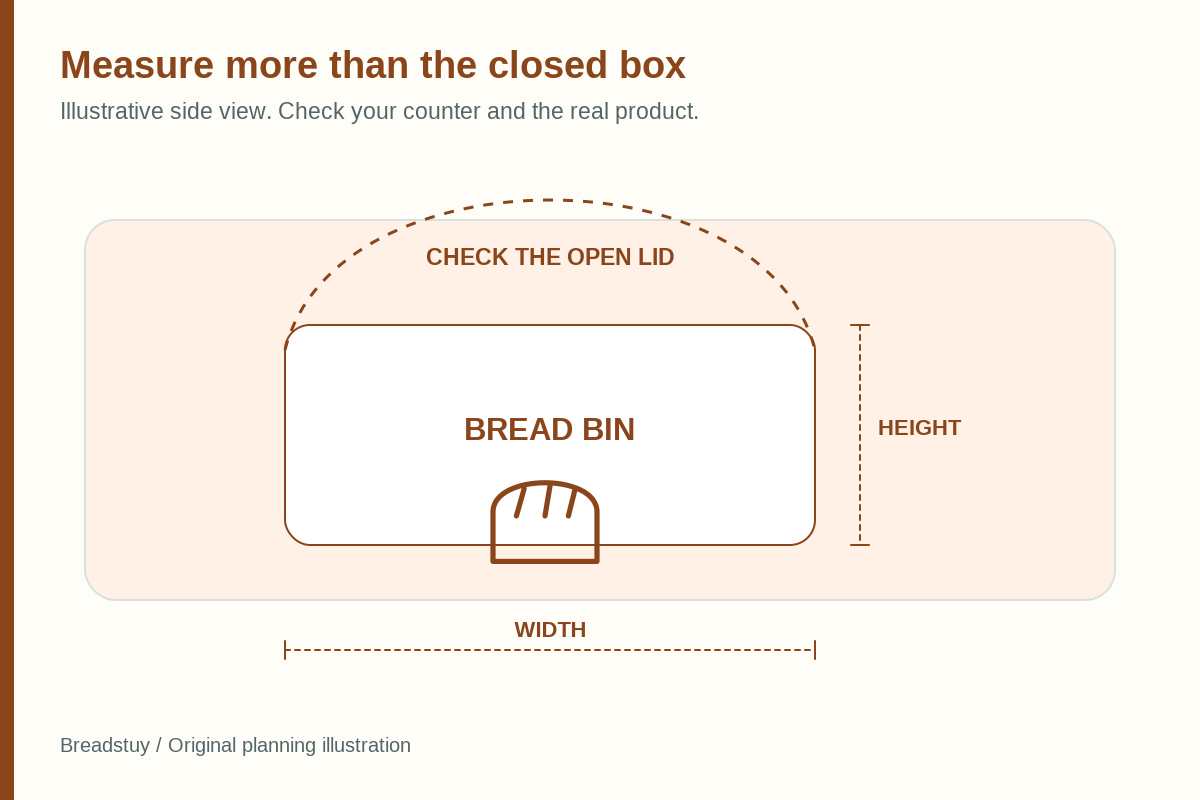
Brabantia’s US listing for roll-top bread box 312601 gives a width of 44.5 cm, a length of 26.2 cm and a height of 17.3 cm. Its lid retracts inside the bin. These are manufacturer specifications checked on 24 November 2026, not measurements from our own test.
Outer dimensions help you plan the footprint, but they do not establish the exact interior shape or whether your packaged loaf can pass through the opening. Confirm the opening and usable interior with the seller or manufacturer when that is the deciding factor. A rolling lid can change the space needed to open the bin, but it still needs an accessible front.
Make a paper footprint
Mark the candidate’s outer footprint on paper and put it on the proposed counter. Practice the surrounding tasks: opening cupboards, setting down groceries and preparing a meal. Add a simple upright paper marker for the height if an overhead shelf is involved.
Illustrative calculation: a 50 cm counter strip minus a 44.5 cm bin leaves 5.5 cm in total. It does not leave 5.5 cm on each side. Whether that remainder is useful depends on the adjacent objects and the access you need.
Resolve the last purchase questions
- Exact model and current manufacturer dimensions confirmed.
- Usual contents compared with usable interior and opening.
- Door or lid motion included in the counter test.
- Surrounding work and appliance instructions respected.
- Cleaning and material-care instructions checked.
- Return conditions checked if the interior fit cannot be established before purchase.
Bread-bin measurement sheet
| Check | Your measurement | Candidate information |
|---|---|---|
| Usual contents | Width × depth × height | Usable interior / opening |
| Counter area | Usable width × depth | Outer footprint |
| Overhead space | Measure actual location | Outer height and opening motion |
| Daily access | Try neighboring tasks | Record what remains awkward |
Put the plan to work
Use your own information to make a practical next step.
Space-fit calculatorSources and review
These sources support the factual details in this guide. Policies, prices and services can change; check the official source before acting.
- Brabantia US: roll-top bread box 312601Checked November 24, 2026
Manufacturer specification example checked 24 November 2026. This is a fit-planning guide, not a hands-on review or a promise about bread freshness.
How these guides are prepared